(718) 957-8695
 CALL US NOW
 EMAIL US NOW


Rideshare accidents in the Bronx leave victims confused about who covers their medical costs — the driver, Uber or Lyft, or their own insurance.
Getting into an Uber or Lyft should feel like the safest option on the road. But accidents happen, and when they do, the billing picture gets complicated fast. Between the Grand Concourse, the Cross Bronx Expressway, and the densely trafficked streets near Yankee Stadium and Fordham Road, rideshare vehicles are everywhere in the Bronx and Westchester County. So are the crashes that come with high-volume traffic.
If you were hurt in a rideshare accident, one question likely dominates your thinking: Who is actually responsible for paying your medical bills? The answer depends on the specific circumstances of your ride and which insurance coverage applies at the moment of the crash.
How New York’s No-Fault Insurance Applies to Rideshare Accidents
In New York, no-fault insurance covers “basic economic loss,” subject to statutory and policy limits, exclusions, verification, and medical-necessity rules, regardless of who caused the accident.
New York is a no-fault state, which means your medical bills are typically paid first through Personal Injury Protection (PIP) coverage, not through a fault-based claim. Under New York Insurance Law Section 5102, PIP covers reasonable medical expenses, lost wages, and other out-of-pocket costs subject to applicable policy limits—while New York’s ordinary statutory minimum is $50,000, NYC TLC rules require higher coverage, such as up to $100,000 for licensed for-hire vehicles, regardless of who caused the accident.
For rideshare passengers, no-fault benefits are generally filed with the insurer of the vehicle occupied at the time of the crash, though exact priority depends on vehicle licensing, location, policy terms, and occupant status. You do not need to prove the driver was at fault to access these benefits.
The key is filing promptly. New York law requires you to submit a no-fault application within 30 days of the accident. Miss that window, and you may have your benefits denied, unless you provide written proof of a clear and reasonable justification for late notice.
Understanding Uber and Lyft’s Insurance Coverage Tiers
Uber and Lyft provide different levels of insurance coverage depending on what the driver was doing at the exact moment of the crash.
This is where many accident victims get tripped up. Rideshare insurance is not a single flat policy — it varies depending on the driver’s status within the app.
- App off: Only the driver’s personal auto insurance applies. Uber and Lyft provide no coverage.
- App on, waiting for a ride request: though commercial-use exclusions may apply unless the driver has a rideshare endorsement or commercial policy; Uber and Lyft provide no coverage — $50,000 per person/$100,000 per accident for bodily injury and $25,000 for property damage.
- Ride accepted, or passenger in the vehicle: Uber and Lyft provide at least $1.25 million in liability coverage during the prearranged trip, subject to current statutory and policy terms.
If you were a passenger when the accident occurred, you fall under that third tier. That substantial coverage applies once the driver accepts the ride and is engaged in the prearranged trip, including travel to pick up the passenger and continuing through trip completion, as governed by statutory and policy definitions.
What If Another Driver Caused the Crash?
If a third-party driver caused the rideshare accident, their liability insurance may provide damages recovery for your injuries, though it does not replace the rideshare vehicle’s no-fault process for immediate medical and wage benefits.
Rideshare accidents are not always the rideshare driver’s fault. Rear-end collisions, red-light violations, and distracted driving by other motorists are common causes of crashes along busy Bronx corridors like Jerome Avenue or Boston Road, as well as on Westchester County roads like White Plains Road and Central Avenue.
When another driver is at fault, their liability insurance covers your damages beyond what no-fault provides. If that driver carries insufficient coverage, Uber and Lyft’s uninsured/underinsured motorist policies may apply, subject to the specific provisions of VTL §1693 and current applicable policy terms.
New York’s serious injury threshold under Insurance Law Section 5104 must be met before you can bring a personal injury claim for non-economic loss (such as pain and suffering) against an at-fault driver. Qualifying injuries include significant disfigurement, fractures, permanent limitation of a body organ or member, and others defined in the statute, taking into account recent legislative updates.
Can You Sue the Rideshare Driver Directly?
You can pursue a personal injury claim against an Uber or Lyft driver if their negligence caused your injuries and you meet New York’s serious injury threshold.
Rideshare drivers are classified as independent contractors, not employees, under both Uber and Lyft’s terms of service. This is a factor, though contractual classification alone does not automatically resolve all issues of vicarious liability or direct negligence. Even so, at least the statutory minimum liability coverage applies during covered periods, subject to specific policy terms, providing a path to recovery.
Gathering evidence quickly is critical. Preserve your trip receipt, take screenshots of your route history in the app, collect contact information from witnesses, and seek medical treatment immediately. Prompt medical evaluation helps document symptoms and causation, though it does not guarantee claim approval.
Pursuing Compensation in the Bronx and Westchester County
Rideshare injury claims may be filed in an appropriate New York court based on statutory venue rules.
Jurisdiction matters. A lawsuit may be filed in an appropriate court based on venue rules, which consider where the accident occurred, where parties reside or do business, and the nature of the claims. Knowing where to file and how local court procedures work affects your timeline and strategy.
New York’s statute of limitations for personal injury claims is three years from the date of the accident under CPLR Section 214, though claims involving municipalities, public authorities, wrongful death, or minors carry much shorter deadlines and specific notice requirements. While three years may feel like plenty of time, evidence disappears, witnesses become harder to locate, and no-fault deadlines are measured in days, not years. Acting early matters.
How The Law Offices of Thomas J. Lavin Can Help
Rideshare accident claims involve multiple insurance policies, competing coverage tiers, and strict filing deadlines. The Law Offices of Thomas J. Lavin represents injured riders and pedestrians throughout the Bronx and Westchester County, fighting to recover the full compensation they are owed for medical bills, lost income, and pain and suffering.
You do not pay unless we win. Call us at 718-957-8695 or contact us to discuss your case at no cost.



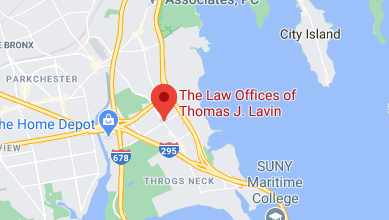
 3559 E Tremont Ave,
 (718) 957-8695